What are the new breakthroughs in China’s first long-range maneuvering launch of the Jetdragon three carrier rocket at sea?
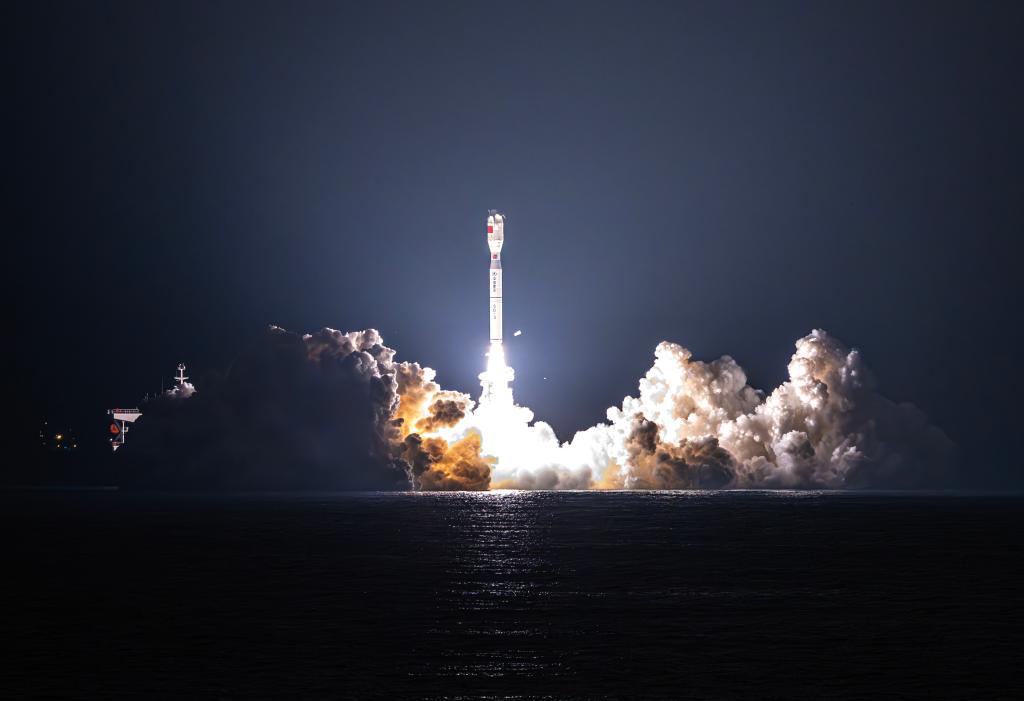
At 3: 24 on December 6, China’s Taiyuan Satellite Launch Center used the Jie dragon three carrier rocket in the waters near Yangjiang, Guangdong Province, and successfully launched the satellite Internet technology test satellite. The satellite successfully entered the scheduled orbit and the launch mission was a complete success. Xinhua News Agency (photo by Zhang Jingyi)
In the early morning of December 6th, China’s Taiyuan Satellite Launch Center used the Jie dragon three carrier rocket in the sea area near Yangjiang, Guangdong Province, and successfully launched the satellite Internet technology test satellite. The satellite successfully entered the scheduled orbit and the launch mission was a complete success. This mission is the first application launch mission of Jie dragon three carrier rocket after its first successful flight, which marks the prelude of Jie dragon three carrier rocket’s application launch.
Jiedragon three carrier rocket was developed by the First Academy of Aerospace Science and Technology Group and invested by China Rocket Company affiliated to the First Academy. It has the characteristics of "strong carrying capacity, large fairing envelope space, diversified launching methods, good economy, high launching efficiency and short performance period". The carrying capacity of 500 km sun-synchronous orbit is 1.5 tons, and the preparation and launch of satellite and arrow technology can be completed within one week. It is a type of solid carrier rocket built to meet the needs of rapid networking launch of future satellite constellations.
This launch is the first time that China has carried out a long-distance mobile launch mission at sea. The launch vehicle of Jie dragon three, which started from the technical service port of marine launch at Dongfang Aerospace Port, lasted for five and a half days and traveled more than 1,300 nautical miles, and reached the sea near Yangjiang, Guangdong for the first time to launch. In this sea area, launch missions in the south direction, such as near-polar orbit and sun-synchronous orbit, can be carried out offshore, further verifying the adaptability of rockets for long-distance maneuvering launch at sea.
Jin Xin, commander-in-chief of Jie dragon three carrier rocket, said that the long-distance maneuvering launch at sea requires higher rocket reliability because of the complicated sea conditions and the long distance from the home port. Therefore, the launch ship is equipped with a thermal insulation shed, which can provide a stable temperature and humidity environment for the Jie dragon three launch vehicle during transportation. At the same time, the Jie dragon three carrier rocket has the ability to transport in class 4 sea conditions and has strong environmental adaptability. This launch verified the long-range maneuvering launch capability of the Jie dragon three carrier rocket at sea, and improved the adaptability of the rocket mission.
Guan Hong Ren, chief designer of Jie dragon three launch vehicle, introduced that after the design of the rocket body, the rapid integration design of the satellite-rocket interface and the optimization of the launch process, at present, Jie dragon three launch vehicle has the conditions for the mass assembly of the rocket body, which shortens the mission response time and further compresses the performance period, and can adapt to the complex and changeable characteristics of commercial satellite launch missions and meet the future high-frequency launch requirements.
Behind the successful development of Jie dragon three carrier rocket, many technological innovations have been realized. One of its highlights is relying on the industrial software independently developed by the First Institute of Aerospace Science and Technology Group, making full use of simulation design and test technology to build the Jie dragon three launch vehicle, and innovatively using the digital twin-powered rocket to develop.
"We have gradually expanded from physical test to simulation and equivalent test, simulation test and other means, taking into account the integrity, effectiveness and economy of the test, and changed from traditional ground test to overall simulation design, which has effectively promoted the development process of using digital twins to empower Jie dragon three launch vehicle." Liu Jiajia, deputy director of the General Office of the Rocket General Design Department of the First Academy of Aerospace Science and Technology Group, said.
At present, the first-phase project of Shandong Haiyang Solid Launch Vehicle Assembly Test Base of China Rocket Company, where the solid launch vehicles such as Jie dragon three are located, has an annual production capacity of 10 rockets. Before the end of this year, the second phase of the project will be completed, and it will have an annual production capacity of 20 solid launch vehicles, which can effectively meet the launch needs of various commercial satellites.
According to the plan, the Jie dragon three carrier rocket will carry out more than five launch missions in 2024. (Reporter Song Chen)