
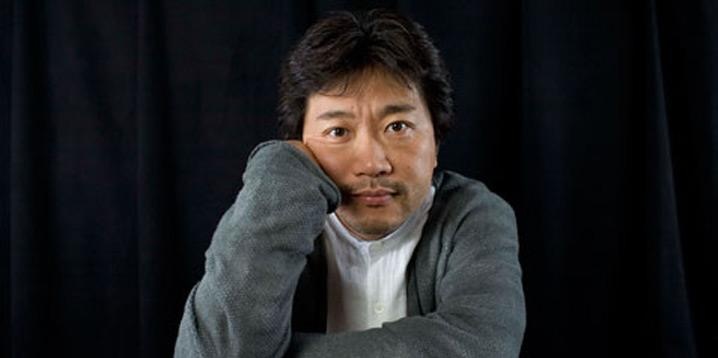
Hirokazu Koreeda’s movie package was snapped up at the Beijing International Film Festival.
Special feature of 1905 film network In the special collection "Walking on, Hirokazu Koreeda", the director’s debut film, the scene of the seaside funeral, was included. Like a script, the split-mirror painting is intended for reference and guidance, which requires a high degree of enforceability. Therefore, the brushstrokes of this group are also very simple, and the outlines of characters and scenery are even childish and lovely, but they just have the ability to stop people’s eyes and don’t want to move.
What is it? It’s hard to understand, and it’s probably impossible to express one’s mind quickly. If you think about it carefully, perhaps the most attractive thing is the loneliness of the young people (protagonists) in the painting. This group of mirror paintings is directly reminiscent of the final film, in which the heroine played by Makiko Esumi is unable to get rid of her depression and follow the big team like a lost soul. A group of people kept a noteworthy distance from one person, and she seemed to be left behind, with no support and no roots to chase.
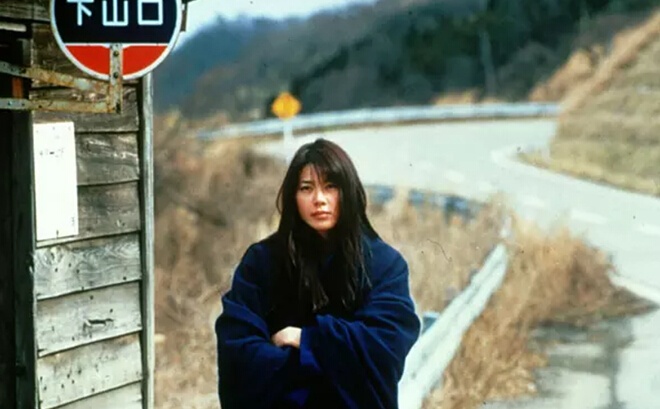
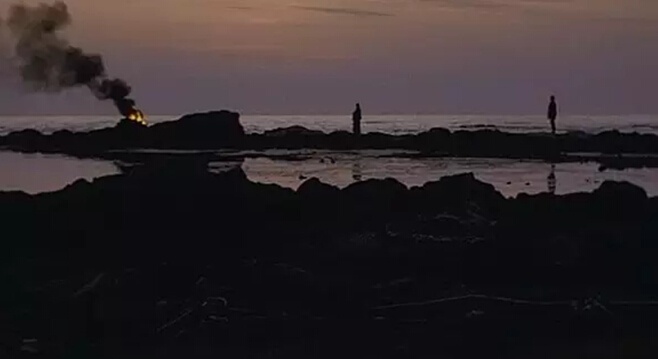
The seaside funeral scene of "Magic Light" is impressive.
Hirokazu Koreeda, who graduated from Waseda University, has a strong command of writing, especially in his images. However, he is full of pen and ink in his leisurely walk. He said that "sadness and loneliness are not directly mentioned, but expressed", and the ideal form of creation may be to examine time and convey feelings like a chorus. If "not saying clearly" is the foundation, rhyme and creed of short poems, then the reason why the audience likes Hirokazu Koreeda’s works may be similar to the interest in appreciating paintings.
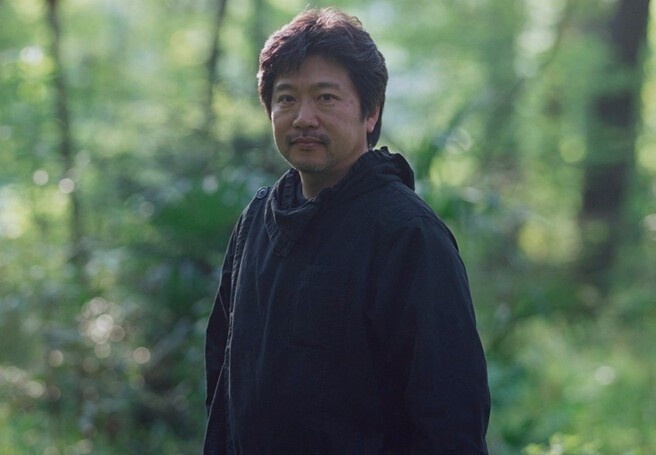
The 7th Beijing International Film Festival has launched a special film exhibition in Hirokazu Koreeda, and the director’s first meeting has also been held in Broadway MOMA tonight. Let’s go back with us to the creative process of this representative figure of the "new wave of new Japanese movies" and capture the gaps between the fleeting images.
Pathfinding
Hirokazu Koreeda’s "Fenfu" founded in 2014 is a film company, but in the photos, it has a particularly intimate feeling of "family workshop". Posters of such works are arranged on the wall, the scenery outside the window shaded by green leaves is quiet, and there is a tumbler full of Japanese style. But perhaps the most striking thing is the calligraphy written by the director himself: "Following". Why continue? The square and meaningful rhyme between black characters on a white background gives people plenty of imagination space.
Tracing the origin of the director’s creation, the film is not the beginning of everything, but the documentary is his starting point. After graduating from college, he joined TV MAN UNION, and his working experience here had a profound influence on him. In his collection of essays "Like Walking Speed", Hirokazu Koreeda summed up the different characteristics of movies and TV very subtly: "If movies are classical music with music scores, TV is jazz." For him, movies and TV works are communication, not the "self-expression" that many people are clamoring for at present. This kind of intention may have saved the burden of trying to express one’s feelings at the top of one’s lungs at the beginning, and it has been favored at film festivals.
The first film was adapted from a novel by the famous Japanese writer Miyamoto Kei, and won the Golden Othello Award at the Venice Film Festival, which raised the starting point of Hirokazu Koreeda’s journey as a director. Later, based on the real abandoned baby incident, Yuya Yagara was elected, making him the youngest Cannes film winner in history by virtue of his performance in the film. "Walking on" is a favorite film of many fans, winning the Blue Ribbon Award for Best Director and Best Supporting Actress. In recent years, his works have often participated in Cannes, won the jury prize of Cannes Film Festival, and were also nominated for the Palme d ‘Or Award, which made him a short-listed concern unit. So far, during his more than twenty years as a director, he has produced eleven films (the new film was released in Japan in September, but it was not included).
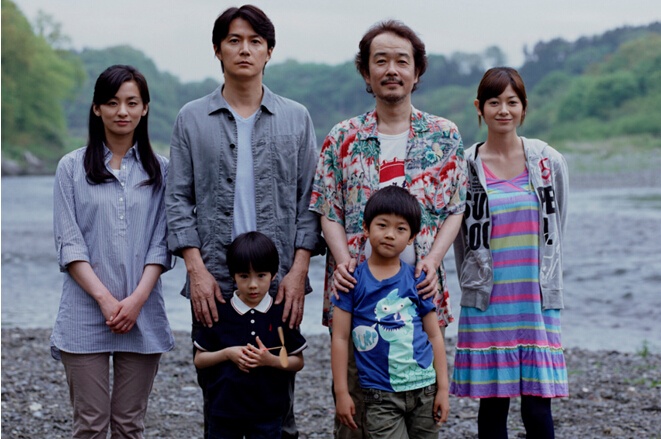
"Like a father like a son" was obtained.the Cannes Film FestivalJury award
It seems that every audience has a different interpretation of his films, but what makes the director’s personal style distinct and independent is undoubtedly his delicate and rich emotions and unique perspective of observing things. But these qualities are not formed for filming, but his innate characteristics. In his essays, he wrote about his passion for ice cream since childhood, and the frozen colpite (lactic acid bacteria drink) became unforgettable. This scene was immediately used in Deeper than the Sea, which was particularly real and interesting. Before moving at the age of 9, he sowed the seeds of cosmos in the yard. When he was filming Miracle, he saw the blooming cosmos in Kumamoto’s dilapidated residential courtyard. He instantly remembered his childhood and came up with the idea of capturing the lens of "being outside the present". The focus of Hirokazu Koreeda’s vision is very interesting. He can always find a scene that ordinary people have never thought deeply, but can have a strong resonance with it.
But it is not entirely accurate to say that the director’s pattern only focuses on family ethics and intergenerational relations. No matter in movies and TV works, or in emotional essays, he shows his keen thinking on world current affairs and social problems. The experience of documentary training his sense of responsibility and logical clear thinking ability, but put it in the film, it becomes a kind of bearing capacity of silently watching and faithfully following and truthfully presenting the characters’ facial expressions, movements and mood ups and downs. Shooting people who are "left behind" and learning from real life will show their dark side and defects without any protection, but they will not put their roles on the moral high ground for trial. The generosity like "documentary" will naturally make the audience feel close. Without the dramatic plot of lamentation, the emotions of the characters are the fulcrum that can control the overall situation in secluded places. Often after reading it, I feel that nothing has happened, but the artistic conception is vividly portrayed, and the lingering sound is lingering.
key element
"Information" is the content of deliberate infusion, while poetry should be the product of unconsciousness. In Hirokazu Koreeda’s films, there are some recurring elements that are brought into the category of close attention and hope to be further explored. They may come from the director’s inner complex that is difficult to explain and explain, and they are invisible icebergs under the horizon.
departed saint
People who have passed away are even more important in the director’s works than the protagonist. In Miracle, Odagiri Joe once said: "The world also needs useless things. If everything is meaningful, it will make people breathless." Inadvertently, a remark demonstrates that "uselessness" is a necessary product. Similarly, "absence", as a kind of existence, has a power that cannot be ignored, and hit the floor. Many times, the dead who have no images in Hirokazu Koreeda’s works have not dissipated and disappeared, and their shadows remain deep and long on their families, still occupying a dominant position, just like the overgrown moss.
Yumiko’s life track, which can’t understand why her ex-husband suddenly committed suicide, has taken a major turning point, with a little magical color, and the protagonist is the dead in heaven. Influenced by Aum Shinrikyo, the eyes are on the families of criminals, and their remaining memories are like seals; The eldest son in "Walking on" died because of rescuing a drowning child, but the heavy damage caused by this incident can’t go away, and the mother (KiKi KiRin) still invites the rescued people to pay homage at home every year; The father in Diary of the Sea Street died at the beginning. The past of this character is all pieced together by the memories of four daughters. In the state that the characters are often aphasia, the influence of "father" on their personality formation can be clearly seen. The seemingly detached mother in Deeper than the Sea has not actually cleaned up all her husband’s relics.
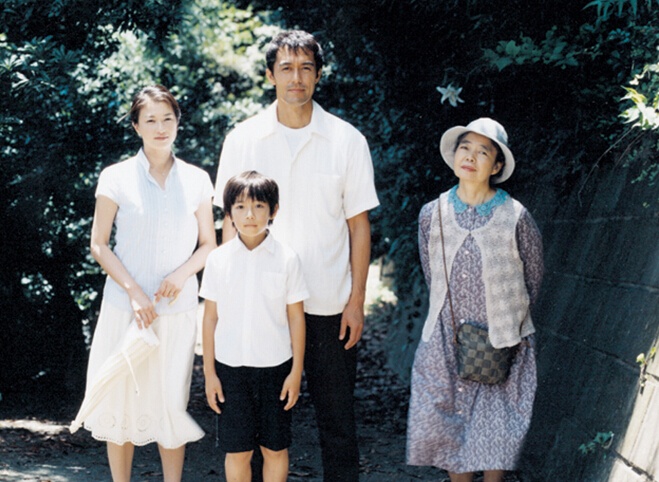
A family in "Keep Walking"
Why always describe "death"? The director’s own statement is: "There is no absolute god in Japan, and it is probably the dead who replace it. There is a saying that’ there is no words to face the ancestors’. If you want to live a clean life, you need the existence of the’ dead’. " He used death as a reference to reflect the state of survivors, and for a period of time he was particularly obsessed with people’s mixed feelings during mourning. The growth of characters is like watering plants. The changes that permeate the spiritual soil are actually very abstract, and it is difficult to be noticed in the process of formation. I always feel that there are no new shoots and the process is futile, but in fact, every bit has echoes. It is also interesting to see people who grow like plants in Hirokazu Koreeda’s films.
child
Apart from the deceased, children are undoubtedly another important element in his works. The four abandoned children in Nobody knows, the two brothers who live far apart in Miracle, shota who needs to face his stepfather and his family in Walking, and Qingduo who has been wrongly held but has been trying to please his father in Like a Son are all outstanding figures. In fact, children are lively and active, and it is difficult to obey the instructions and complete the complex action of "performing", so Hirokazu Koreeda’s method of shooting children is very commendable — — Without a script, he verbally conveyed his lines to the children on the spot. He likes to show his children, perhaps largely because he likes to show the awkward and subtle reorganized family. Hirose Bell in Hai Jie Diary, out of curiosity, also adopted the way of shooting without script.
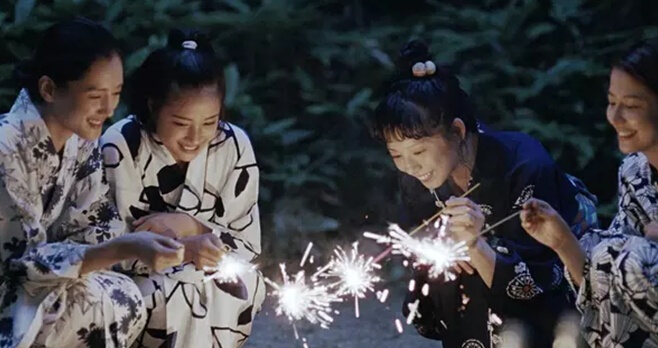
Four Sisters in Diary of the Sea Street
This made Mr. Isao Hashizume, an old opera player who cooperated with Hirokazu Koreeda, also express his envy. However, the price paid is to accumulate trust and cultivate tacit understanding with the children, and spend more time on the spot. Even if it is an audition, it is not a scripted rehearsal, but a fixed situation to observe their on-the-spot reaction. It doesn’t matter if you don’t show your ideal state. Being naive and unsophisticated is probably what the director wants most. This is how Wang Zhilang in Miracle sets the angle, and he brings great surprises to Hirokazu Koreeda.
mother
The image of "mother" has become more vivid and bright in the director’s works in recent years. When it comes to the interpretation of "mother", KiKi KiRin, who has worked with Hirokazu Koreeda for many times, has contributed a lot. No matter in the interview or in the anthology, Hirokazu Koreeda has made no secret of her admiration for this precious actress. Many people are deeply impressed by the "mother" she portrayed in "Walking on", who knows everything cunningly and stubbornly remembers her lost eldest son. Being regarded as the sequel to Walking on, Deeper than the Sea, she also contributed a lot of golden sentences. Carefully sound out her son’s ex-wife (Miki Yoko) and ask them if there are any possible fragments. Her expectant and uneasy eyes are extremely in place. Even if there is no close-up, she can still act with her stooped back.
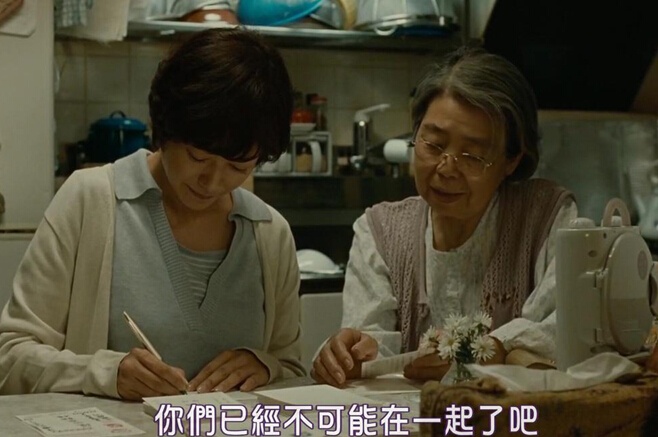
Perhaps because of the regret of "not being able to do anything for my mother", the images of mothers in Hirokazu Koreeda’s films are always full and kind, without the raw feeling of virtual characters. At the Sebastian Film Festival, an overseas audience asked the director, "Why do you know my mother so well?" It is a pleasant surprise for the director to explore his inner experience but gain universal resonance.
When faced with the title of "Ozu’s successor", Hirokazu Koreeda always seems very helpless. He thinks that he has learned more ways to shoot people and space from Mikio Naruse’s films, without considering Ozu. In addition, his father once lived in Taiwan Province, and when he saw the films of Hou Hsiao-hsien and Yang Dechang, Hirokazu Koreeda felt a kind of affinity, so he was deeply influenced by these two directors. However, the script "Walking on" was written when he visited the "Maoqi Pavilion" (an ancient hotel where Ozu had been stationed for a long time), and his works were difficult to be completely separated from Ozu’s works.
In his films, there are strolling steps, courtyards full of Japanese customs, magnificent seas and the most trivial life scenes, which are like everyone’s ordinary day reflected on the big screen, but they don’t feel boring and lengthy, but they have a sweet aftertaste. The content of the new work is a court-themed film around homicide, which is quite different from previous works and seems to be the starting point of another journey, which is expected.

关于作者