
[Strugglers are young, a first-line story]
Guangming Daily reporter Party Wen Ting Yan Shenghe
"The photoresist sample is eluted from the chromatographic column to determine the degree of crosslinking and molecular weight, using the separation mechanism of size exclusion." Teng Chao, a young distinguished professor, is explaining the experimental principle to students in the laboratory of Applied Technology Research Institute of Shenzhen Vocational and Technical College.
Don’t underestimate the dimly lit laboratory behind him. Although the area is small, every piece of equipment inside is a "treasure" cherished by Teng Chao. In June this year, it was in this tens of square meters laboratory that the photosensitive polyimide photoresist was developed. Through testing and verification, its performance can meet the import substitution requirements.
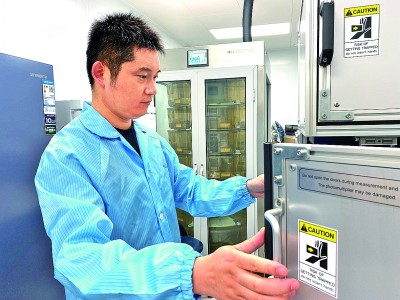
Teng Chao is in the laboratory. Bright picture
From research and development to success, Teng Chao and his team have been studying this project for seven years. Compared with the traditional photoresist, this new photoresist not only plays the role of lithography but also is a dielectric material, which can greatly shorten the working procedure, improve the production efficiency, and make the important raw materials in China’s chip manufacturing supply chain self-controllable.
Although the scientific researcher is young, he is accurate and neat when facing the team, and his gestures reveal calmness and steadiness. This Ph.D. major in polymer physics is engaged in the research of new materials. What made him successful in this field of pursuing speed?
The story began 10 years ago, on the eve of graduation from Nanjing University, when a company came to the door and wanted to conduct joint research and development, so that Teng Chao really understood the current situation faced by China’s photoelectric display and semiconductor industry at that time. "There are a bunch of source technologies behind the screen that are still being ‘ Get stuck in the neck ’ For example, the LCD spacer microsphere material that accurately controls the thickness of the liquid crystal layer has been available for nearly 40 years, but the technology and supply are still in the hands of Japanese companies. "
This made Teng Chao make a bold decision — — Go to Shenzhen, the nearest to the industry, to engage in applied technology research! Teng Chao told the most respected teacher Xue about this idea and got the support and encouragement from the teacher.
Teacher Xue in Teng Chao’s mouth is an example that has the deepest influence on his scientific research. As one of the first doctors in the field of polymer in New China, he often warns Teng Chao, "Don’t stare at the data in research, don’t just want to send papers, but produce more useful results for the industry".
When Teng Chao first challenged the LCD spacer microsphere project, he encountered unprecedented difficulties.
"I can also supplement the technical problems through a lot of reading and experiments. The most difficult thing is to form a team." It turns out that this project is to develop alternative materials rather than breakthrough products, so it is difficult to publish papers, so it is difficult for the research group to recruit people. From doing experiments, collecting data to analyzing and testing, Teng Chao and his partner personally started, "almost lived in the office for more than a year."
Where there’s a will, there’s a way. In the process of cramming lessons and sweating, the interdisciplinary knowledge network gave Teng Chao a "light stroke". He designed a set of algorithms to accurately control the variables in the experiment, and finally succeeded: several factories tested at the same time, and all of them passed at one time for the first time.
This is also the first related product in China that can fully pass the flat panel display industry test and have mass production capacity, breaking the Japanese long-term monopoly in this field for decades. Now all the major domestic flat panel display manufacturers use this high-precision microsphere material with high cost performance.
The success of microsphere research and development has given Teng Chao and the team great encouragement and confidence. In 2015, Teng Chao turned his attention to photoresist, a key material that troubled chip research and development. This kind of material is used for circuit packaging and lithography opening of the core part of the chip, which is monopolized by Japan and the United States and banned from domestic enterprises in many fields.
Many enterprises have a hard time saying — — The shelf life of photoresist is only 6 months, so it can’t be stored in large quantities. Long-term technical monopoly has created a "seller’s market". This monopoly is not only reflected in the final product, but also in the raw materials of the product.
"Take the photosensitizer at the core of photoresist as an example. We need high-purity photosensitizers. There is no supply in China, and Japanese companies refuse to supply them after learning about their purchasing intentions." Recalling the development process, Teng Chao’s face showed a wry smile. "We found that there was no shortcut to raw materials, so we had to set up a new R&D team and start to tackle the synthesis method and purification process from the various components of photoresist."
The project team started with raw chemicals that can be supplied in large quantities in China, and finally got high-purity photosensitizer products and other raw materials that meet the needs of the project step by step. "Although this has lengthened the research and development cycle of photoresist, the establishment of domestic industrial raw material supply chain has completely freed us from being ‘ Get stuck in the neck ’ The possibility. "
"Apply what you have learned and the industry will serve the country." Today, Teng Chao, like his mentor, often exhorts dozens of doctoral and master students in the team. In such an atmosphere, the team attacked one after another "stuck neck" industrial pain points: liquid crystal orientation agent, hardened insulating layer material, electroacoustic sound quality enhancement material.
"When tackling key problems in scientific research, we should not only consider commercial value, but also consider whether it contributes to the country, society and industry." Teng Chao said firmly, "We must master the key core technologies in our own hands!"

关于作者