
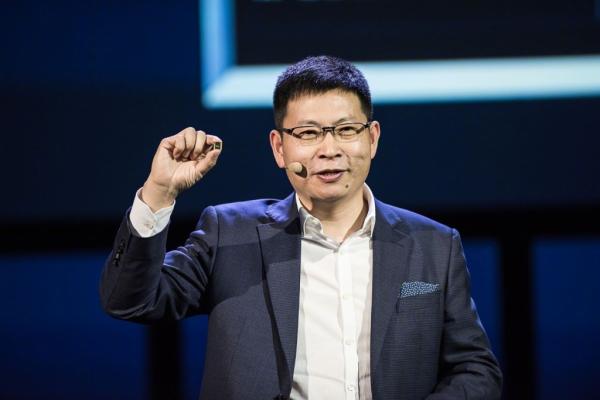
Weibo @ Huawei mobile phone map
On the eve of the release of Apple’s new iPhone, Huawei first released a new generation of system on a chip Kirin 970. Huawei called Kirin 970 "the first artificial intelligence (AI) mobile computing platform" to highlight Huawei’s leading position in the AI field.
On September 2, at the 2017 International Consumer Electronics Show in Berlin, Germany, Huawei released the artificial intelligence chip Kirin 970. Mate 10, the first Huawei mobile phone using Kirin 970, will be officially released in Munich, Germany on October 16th.
Yu Chengdong, CEO of Huawei’s consumer business, said in an interview with Reuters that Huawei’s new chip Kirin 970 provides faster processing speed and lower power consumption for the upcoming flagship model Mate 10 and other high-end mobile phones. Yu Chengdong also said that he believes this will make it better than the iPhone 8 launched by Apple on September 12th and the flagship machine released by Samsung this year.
Set up a special AI hardware processing unit
The chip is the brain of the mobile phone. The biggest feature of Kirin 970 chip is the establishment of a special AI hardware processing unit-NPU (Neural Network Processing Unit), which is used to process massive AI data.
According to industry insiders, in the past, mobile phone chips were generally traditional computing architectures with CPU (Central Processing Unit) /GPU (Graphics Processor) /DSP (Digital Signal Processing) as the core, but this architecture was difficult to support AI massive data computing. To this end, Kirin 970 has set up a special AI hardware processing unit to reduce the burden of CPU, GPU and other architectures, with the aim of improving application efficiency and reducing energy consumption.
This reason is the same as the original intention of adding DSP and other architecture designs in addition to CPU and GPU, in order to share the computational burden of the main system.
According to Huawei’s official introduction, Huawei Kirin 970 integrated NPU for the first time adopts HiAI mobile computing architecture, and its AI performance density is much better than that of CPU and GPU. Compared with the four Cortex-A73 (flagship machine CPU introduced by mobile processor leader ARM last year) cores, Kirin 970′ s new heterogeneous computing architecture has about 50 times energy efficiency and 25 times performance advantages when dealing with the same AI application tasks. This means that Kirin 970 chip can complete AI computing tasks with higher energy efficiency ratio. For example, in the speed of image recognition, it can reach about 2000 frames/minute, which is much higher than the same period in the industry.
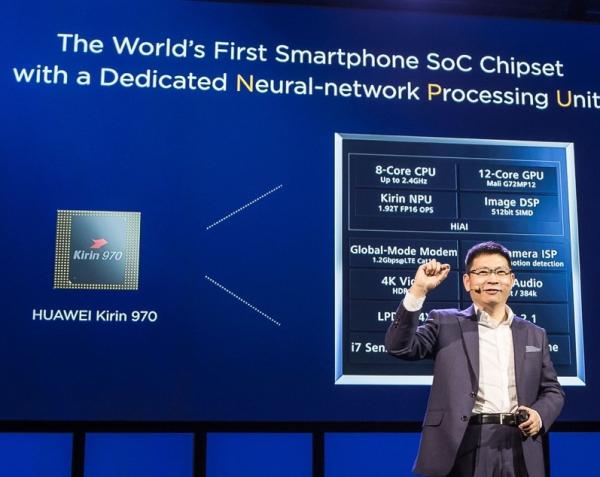
Yu Chengdong, CEO of Huawei’s consumer business, shows Kirin 970 chip.
Adopt CAMBRIAN authorized IP
It is worth mentioning that Huawei used its own HiSilicon Kirin chip to locate high-end mobile phones. But this time Kirin 970 used not Huawei’s own artificial intelligence-related intellectual property rights, but the CAMBRIAN AI authorized IP of the domestic smart chip company.
The CAMBRIAN claims to have created the world’s first "neural network" processor chip capable of "deep learning". Chen Tianshi and Chen Yunji, brothers of Institute of Computing Technology, Chinese Academy of Sciences, are the core developers of CAMBRIAN chips.
"We worked with the Cambrian team to face the terminal and jointly developed and optimized AI. Kirin 970 innovatively designed HiAI mobile computing architecture, using the most energy-efficient heterogeneous computing architecture to maximize the performance of CPU/GPU/ISP/DSP/NPU, and at the same time integrating NPU dedicated hardware processing unit for the first time, its acceleration performance and energy efficiency ratio are much better than CPU and GPU. " An insider of Huawei explained this to the The Paper reporter.
According to the reporter from The Paper, in the field of artificial energy research, Huawei laid out very early. Huawei’s Noah’s Ark Lab mainly conducts research on artificial intelligence algorithms, technical cooperation in managing AI, identification of major application scenarios of AI and demand management. Huawei also announced a strategic cooperation with the University of California at Berkeley to carry out basic research on artificial intelligence.
A person in the chip industry told The Paper that there may be two reasons for adopting CAMBRIAN IP authorization. One is that Huawei wants to build an open ecology and adopt its own chips, which is not very favorable for AI developers; Another possibility is that the integration of AI technology into mobile phone chips is still quite complicated, and Huawei’s own AI technology may be too late.
A system-level mobile phone chip mainly includes CPU/GPU/DSP/ISP, baseband chip and many other components. This time, Kirin 970 still has a built-in eight nuclear CPU, and there is no change compared with the previous generation Kirin 960. On the GPU, Kirin 970 uses the Mali-G72 architecture just released by ARM in May this year, and its performance is improved compared with Mali-G71. In addition, in terms of the number of cores, Kirin 970′ s GPU has also increased from 8 cores to 12 cores.
On the baseband chip, Huawei has played its advantage as a communication equipment manufacturer. Kirin 970 directly supports LTE(4G)Cat.18 (network speed level) with a maximum download speed of 1.2Gbps, which should lead the industry.
Although there are no special surprises in CPU and GPU, the overall performance will be improved because Kirin 970 adopts 10 nm process. Yu Chengdong said that the energy consumption ratio of Kirin 970 increased by 20%.
Huawei’s artificial intelligence strategy
Not only smart chips, but also the artificial intelligence strategy of Huawei’s consumer business was comprehensively explained by Yu Chengdong in his keynote speech on September 2nd.
Yu Chengdong said: "The future smart terminal wants to develop continuously. The corresponding artificial intelligence system must not only give full play to the terminal’s own capabilities and values, but also combine the massive information, services and super computing power brought by big data and cloud technology. The realization of artificial intelligence on future terminals must be coordinated through the end cloud, which is also the focus of our current strategic layout."
Yu Chengdong pointed out in his speech that cloud-side intelligence has been widely used after years of development, but the experience of cloud-side intelligence is not complete. In terms of user experience, there are still some problems in real-time, anytime, stability and privacy, and end-side intelligence can complement the advantages of cloud intelligence. The intelligent and powerful perception ability of the terminal is the premise for the mobile phone to become a person’s busy person and assistant. It has a large number of real-time, scene-based and personalized data. With the support of strong and lasting chip processing ability, the terminal can have a high cognitive ability, truly providing personalized and direct services for users, and at the same time greatly improving the security of local processing of private data.
Judging from Yu Chengdong’s position, after the release of Kirin 970, Huawei’s terminal marketing should take "AI" as a prominent selling point, and start to build an ecology around AI.
In the era of artificial intelligence, the ideal situation is that intelligent terminals will become people’s assistants and truly realize "knowing you", "understanding you" and "helping you". This requires the continuous evolution of artificial intelligence technology, which is not only a passive response to users’ needs, but also a new interactive way to actively perceive users’ status and surrounding environment and provide accurate services.

关于作者