Original title:Seven-day Qingming holiday in Tang and Song Dynasties
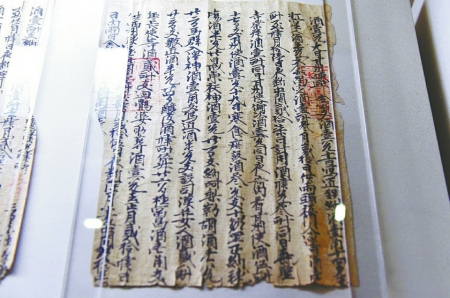
There is a record of wine used in the Cold Food Festival in the Song Dynasty wine bill. Photography LV Jia
"There are many rains during the Qingming period, and pedestrians on the road want to break their souls." More than 1100 years ago, the poet Du Mu used a poem "Qingming Festival" to describe the bleak feeling of the streets during the Qingming Festival in the Tang Dynasty.
Qingming Festival is not only one of the twenty-four solar terms, but also a traditional cultural festival for Chinese to worship ancestors and sweep graves. In this beautiful spring day, when the grass grows and the warblers fly, how did the ancients live a clear life? Looking through the records of Dunhuang documents and materials, combined with the descriptions in Dunhuang murals, we find that the ancient people lived a Qingming festival, which was not only grand, but also interesting. In addition to mourning for their ancestors, they also met for cockfighting, went hiking together, and invited three or five friends to play polo, turning a very important sacrificial festival into a "Qingming Seven Days Music" with long standby.
By the way, during the Tang and Song Dynasties, Tomb-Sweeping Day really had seven days off. Because the mountain is high and the road is long, and the traffic is inconvenient, if officials return to their hometowns to sweep graves, they will spend most of their time on the way back and forth, and a little carelessness will delay their duty. Therefore, Emperor Xuanzong of the Tang Dynasty issued a decree to solve the holiday, stipulating that "cold food and Qingming four days are false". In the sixth year of Zhenyuan (AD 790), the holiday was extended to 7 days. The Song Dynasty also continued this holiday habit, with the Cold Food Festival and Tomb-Sweeping Day Latong having a holiday for 7 days. On the other hand, we only have a three-day holiday now. Will you envy and hate the "Golden Week" of the ancients?
There are solar terms before festivals.
As early as the successful application of the "Twenty-four Solar Terms", Yuan Tingdong, a famous Bashu cultural expert, put forward this view when talking about the difference between solar terms and festivals. "When we talk about solar terms, we must distinguish them from festivals." He emphasized that only one of the 24 solar terms is Tomb-Sweeping Day, and all the other solar terms can’t be regarded as festivals because of sacrificial activities.
What impressed Tomb-Sweeping Day the most was Qingming Ba. "In addition to going for an outing and sweeping the grave, Tomb-Sweeping Day had one thing to do as a child, and that was Qingming Ba. The white powder is dyed with even leaves, which makes people drool. " However, when it comes to the origin of Qingming, there should be solar terms before festivals appear.
As early as the Qin and Han Dynasties, the 24 solar terms system was formed, with a history of more than 2,000 years. Qingming is one of the solar terms. Liu An in the Western Han Dynasty wrote in "Huai Nan Zi Tian Xun" that "on the 15th day after the vernal equinox, when you point to B, the wind will be clear". Qingming wind is a refreshing and clear wind. Most of the time when Qingming wind comes is in March, so Qingming is also called "March Festival". The earliest record of Qingming in Dunhuang documents can be found in the "March Festival on the 11th Qingming Festival" in the 450-year Calendar of the 11th year of the Northern Wei Dynasty Taiping Zhenjun.
In Song Dynasty, Chen Yuanliang further explained the word "Qingming" in the book "Guang Ji at the Age of Years": "Qingming means that things are pure and clean". The book "A Hundred Questions at the Age of Years" also explained: "Everything grows clean and bright at this time, so it is called Qingming." Qingming Festival has risen from a solar term to a festival, which is closely related to the Cold Food Festival. The custom of Cold Food Festival is to ban fire and cold food and to pay homage to ancestors. Because Qingming and Cold Food Festival are very close, people often extend the custom of sweeping graves to Qingming. In the Tang and Song Dynasties, cold food and Qingming gradually merged into one, and even in the Song Dynasty, Qingming developed from an accessory of the Cold Food Festival to a great replacement.
Tomb-Sweeping Day became the Golden Week in Tang Dynasty.
As early as before the Qin dynasty, there was a custom of sweeping graves to worship ancestors in China, but it was not necessarily on Qingming Day. It was not until the Tang Dynasty that the Cold Food Festival or grave sweeping in Tomb-Sweeping Day became popular. In the 20th year of Kaiyuan (AD 732), Emperor Xuanzong of the Tang Dynasty ordered the world to "eat cold food to the tomb", which was listed as one of the "Five Rites" at that time. "Old Tang Book" records: "Cold food goes to the tomb, courtesy goes without words, modern times follow each other, and it is a common custom. It is appropriate for a scholar to go to the tomb and make it a five-ceremony, which will always be a routine."
Since Tomb-Sweeping Day is already a festival, can the ancients take a paid vacation? In fact, officials in different dynasties enjoyed different vacation benefits, but since the Tang Dynasty, Tomb-Sweeping Day has become a small holiday after the Lantern Festival.
The imperial court in the Tang Dynasty gave officials a holiday like this: "Yuan Zheng and Winter Solstice were given seven days each, cold food was given to Qingming on the fourth day, and August 15th, Summer Solstice and La Ri were given three days each". In other words, if you are an official in the Tang Dynasty, you will have 7 days off on New Year’s Day and Winter Solstice, 4 days off on Qingming and Cold Food Festival, and 3 days off on Summer Solstice, Mid-Autumn Festival and Laba. This record is consistent with the Dunhuang document "The appearance of Shazhou’s performance in the third year of Guangqi (887)": "Drive into the cold food for five days and leave on the eighth day."
This holiday arrangement seems to be full of happiness now, but it has been adjusted several times in the middle. When Li Heng, Tang Suzong, was emperor, perhaps he was worried that officials would rush back to his hometown to visit the grave too hard, so he extended the holiday of cold food and Qingming to seven days, and shortened the number of days for the emperor’s birthday celebration set by Emperor Xuanzong of Tang Dynasty from three days to one day, and Tomb-Sweeping Day became the "Golden Week" for the first time.
Compressing the days of the emperor’s birthday celebration and extending the holidays in Tomb-Sweeping Day, this move shows the weight of Tomb-Sweeping Day in the hearts of the Tang people. However, after Li Heng, Prince Li Yu succeeded to the throne as Tang Daizong, and he changed the Qingming holiday to five days. Then, when his son Li Shi was a Tang Dezong, he resumed the practice of Li Heng era, combining cold food with Qingming, and enjoying the "Golden Week" without taking a vacation.
Tomb-Sweeping Day, a national legal holiday, continued the tradition of seven days’ holiday in the Song Dynasty, with an unprecedented degree of excitement. This festival was shortened to three days in Yuan Dynasty. In the Ming and Qing dynasties, the second festival of cold food and Qingming completely withdrew from the luxury package of national legal holidays.
Li Bai loses a cockfight.
Cockfighting game, which started in the Spring and Autumn Period, was particularly popular in the Tang Dynasty. According to some scholars’ statistics, the word "cockfighting" was mentioned in more than 50 places in The Whole Tang Poetry. Li Bai, a poet, even lost his envy because of cockfighting, and even got several ruffians.
As mentioned above, Li Longji, the Emperor Xuanzong of the Tang Dynasty who made Tomb-Sweeping Day a national holiday, was not only a chicken in life’s core monuments, but also a cockfighter. He often holds large-scale cockfighting competitions in Chang ‘an, especially on the three major festivals of Lantern Festival, Tomb-Sweeping Day and Mid-Autumn Festival every year, and he wants to gather people to have cockfighting to show that the world is at peace. "The Biography of the Old Father in Dongcheng" records: "When Xuanzong was in the official residence, he enjoyed the folk Tomb-Sweeping Day cockfighting." When fighting cocks, he also let court bands and harem beauties come out to entertain, watch well-trained fighting chickens, and constantly change formations after understanding the password.
Liu Yanyan, a folklore expert from Dunhuang Research Institute, found that cockfighting activities were mostly concentrated during cold food and Tomb-Sweeping Day Day. Du Yan’s poem "Ode to the Cold Food Fighting Chicken Should Follow the Qin King’s Religion" vividly depicts the intense scene of the cold food festival fighting chicken: "Cold food is on the eastern outskirts of the road, and the competition is coming out. At the beginning of the corolla, the mustard feather is blowing. Take care of the enemy’s bosom and courage, and first sound the heroic spirit. Long warping frequency sweeps the array, and the claws are repeatedly passed. Flying hair all over the green field, sprinkling blood-stained fragrant clumps. Although you win a hundred times, you will not care about your merits. " On the day of Cold Food Festival, people fought cocks in the suburbs. The battle-hardened cock held his head high, hid mustard under his wings, and his sharp claws caught his opponent’s blood. The scene was thrilling.
The Dunhuang document "Cold Food, Sleeping and Illness, Happy Li Shaofu’s Search" records: "The weak crown has ascended the dragon early, and now it is happy to meet again. How do you know the willow in the spring and the moon? Fireworks are cold food, and songs are loud. Fighting cocks, having fun and admiring friends. " It means that during the cold food and Tomb-Sweeping Day in Dunhuang in the Tang Dynasty, Dunhuang people gathered on the roadside, shouting and fighting cocks, which was very lively.
Play polo together in leisure and boredom.
In the view of Li Yang, a teacher in the Museum of Chengdu Institute of Physical Education, Tomb-Sweeping Day not only has the sad tears of worshipping his ancestors, but also the laughter of playing outdoors, and the festive atmosphere is rich. Polo is one of these outdoor sports, and Dunhuang murals depict some scenes of ancient people playing polo.
Polo was quite popular in the Tang Dynasty, and there are many accounts of Tomb-Sweeping Day playing polo in ancient books and documents. For example, Zhang Ji’s "Two Banquets in Cold Food" mentioned that polo is one of the entertainment activities of the Cold Food Festival. "The chef under the porch distributes cold food, and the incense rides in front of the temple to chase the flying ball." When the chef distributes the prepared cold food to everyone, the chasing teenagers ride horses and hit the ball in front of the temple.
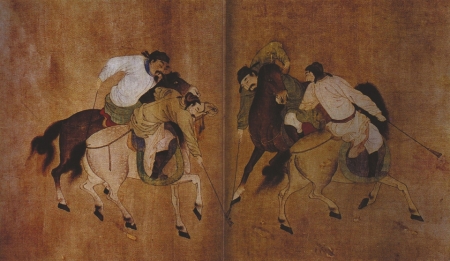
"Song Man’s Hitting Map" is collected by Albert Museum, Victoria, UK.
During the Tang and Song Dynasties, people in Dunhuang played polo the most popular. According to the Dunhuang document "Flying Polo before the Staff", "When it is mid-spring, the vegetation is new, the road is clean after the rain at the beginning of the mouth, and the flowers and horses are often in the forest, and the beauty is always seen upstairs. Call for sympathy and talk together, and swim around the stadium in a leisurely way, pass the ball with a white jade whip in his hand, and Dou Shi rides a purple camel. " "Shi Zhongchun" points out that the time of holding polo match in Dunhuang in ancient times was cold food and around Qingming Festival. This poem vividly describes the popularity of polo, and even the beauties in the attic are attracted by the young lang and go to the stadium to play polo together.
What did polo equipment in Dunhuang look like more than a thousand years ago? The crescent-shaped ball fights can be clearly found in the maps of Cao Yijin’s Travel in Cave 100 of the Five Dynasties in Dunhuang Mogao Grottoes and Vimalakīrti Jingbian on the east wall of Cave 61 of the Five Dynasties. In Cave 144 of the late Tang Dynasty, there are even worshippers holding ball fights. It can be seen that polo was popular at that time, and ordinary painters could accurately grasp the shape of polo clubs.
However, the lively Dunhuang people in ancient times, outdoor leisure and entertainment projects are not limited to this. The Dunhuang document "Cold Food" records: "Runan chicken fights in the flower field and travels all over the eastern suburbs in spring. The golden treasure account is decorated with tassels, and Bo Qiong is still sitting in the brocade banquet shop. Mochow’s eyes are heavy and the windows are dark, so she has her own golden urn to shine on the pearls. The heart moves to the place where the traveler swims, and he wants to take the boat to Ling Bo. The water in the pool flies in white, and the colorful warblers are thrown under the trees … "According to the poems, besides playing polo, the Cold Food Festival also has a series of entertainment activities such as swinging, spring outing, horse riding, cockfighting and colorful ball throwing, and it is full of singing and dancing, and a thriving holiday atmosphere.
It’s the right time to travel by song.
"Pear blossoms are clear, and wanderers are looking for spring and half out of the city. At dusk, the songs are packed away, and ten thousand willows are warblers. " In Song Dynasty, Wu Weixin’s "Qingming is the Thing in Su Causeway" recorded the happy mood of the wanderer who traveled by singing on Qingming Day. As far as solar terms are concerned, Qingming is in full bloom in spring, the grass grows and the warblers fly, and at the same time, they can enjoy the beautiful scenery along the way, which is really wonderful.
The poem "Bodhisattva Man’s Qingming Festival" in Dunhuang literature describes that during the Qingming Festival, a graceful girl met a teenager riding a horse during an outing, and her heart was like a deer: "Tomb-Sweeping Day is near Qian Shan, and her waist is as light as a bundle. Nine strangers are in full bloom, and teenagers are riding horses. Luo shirt has thin sleeves and pretends to be drunk and throw a whip. Why look back, add spring night sorrow! "
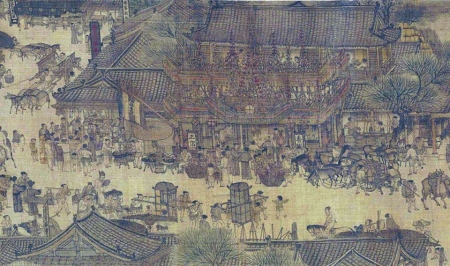
Part of The Riverside Scene at Qingming Festival depicts the unprecedented scene of market excitement in Song Dynasty.
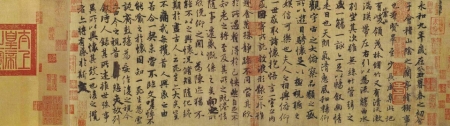
Wang Xizhi’s copy of Preface to Lanting Collection.
The ancient custom of going for an outing on Qingming Festival has a long history. The painter Zhang Zeduan’s "Riverside Scene on Qingming Festival" depicts an unprecedented scene in which the people of Bianjing went for an outing and the market was lively during the Qingming Festival in the Song Dynasty. However, this custom of going for an outing in Qingming may have absorbed the essence of the third day of the third lunar month. The most famous Shangsi Festival in history originated from Wang Xizhi’s Preface to Lanting Collection. On the Shangsi Festival in the ninth year of Yonghe (AD 353), Wang Xizhi and more than 40 senior military and political officials, including Xie An and Sun Chuo, were drinking and writing poems in Lanting, Shanyin (now Shaoxing, Zhejiang). The gathering of literati and elegant guests is naturally accompanied by wine and music. With the sound of the bamboo and string, the poets played a game of flowing water-holding wine in a lacquer glass and letting it drift in a curved waterway. Whoever stops in front of the glass has to improvise poetry, otherwise it will lead to drinking.
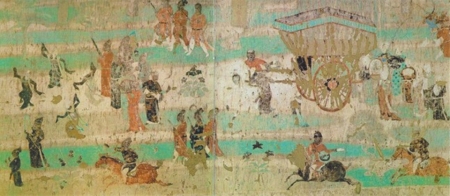
Mrs. Song’s travel map depicts the grand scene of the Tang people’s outing.
Of course, Tomb-Sweeping Day of Dunhuang people also has a special taste. With the help of Dunhuang frescoes, we traveled back to Tomb-Sweeping Day where the spring breeze swept our faces and we met for an outing. At the Dunhuang Art Exhibition in Chengdu Museum, there are several murals that reflect the people of the Tang Dynasty going out for an outing. The scenes are high-profile and luxurious, and the battle is scary. For example, in Cave 130 in the prosperous Tang Dynasty, the Tutu of the Tudu Lady’s Ritual to the Buddha was a lady of the Tang Dynasty, Wang of Taiyuan, who took her daughter and maid and a group of 12 people out to pay homage to the Buddha. There are weeping willows, day lilies and bees and butterflies behind the elegant women with exquisite makeup. Combined with their dresses, it can be speculated that the time is probably in the spring and March. If you have little interest in the scene of this lady’s outing, you may wish to visit the Travel Map of Mrs. Song in Cave 156 in the late Tang Dynasty. The wife of Zhang Yichao in Hanoi County, Song, went on a spring outing on a high horse, with a variety of acrobatics in front, accompanied by a band, bodyguards escorting the way, and a large number of attendants holding gold and silver in their hands and transporting food, wine and meat with camels. Is this luxurious and grand scene more than that of Prince Dubai walking the tiger in a luxury car?
Liu Yanyan of Dunhuang Research Institute has specially studied the custom of ancient people’s feasting. Its beautiful scenery is naturally accompanied by wine, food, music and dance, so that people can enjoy themselves. The Guiyi Army’s Mansion Wine Breaking Calendar, commonly known as the Wine Account, kept 213 public expenses from April 9 to October 16, one of which was "On the 19th, there were three wine jars in the cold food restaurant", which was the record of Guiyi Army’s Mansion entertaining guests with wine during the cold food festival. It can be seen that the official consumption during the festival was very large.
In ancient Dunhuang, there was also a custom of eating cold food and stepping on songs. Because Dunhuang is a settlement of ethnic minorities, stepping on songs was influenced by Hu dance in the western regions, that is, Hu dance was "vigorous" accompanied by the song Su Muzhe. It is said that this kind of dance is passionate and very popular among Dunhuang people.
"Don’t wear a willow beauty to become a bright head in Qingming Festival"
Another custom that the ancients visited Tomb-Sweeping Day was inserting willows, which reached its peak in the Song Dynasty. According to the Song Dynasty poet Wu Zimu’s Dream Liang Lu, in Tomb-Sweeping Day, wicker was inserted on the door of every household, and the custom was like inserting mugwort at the door during the Dragon Boat Festival.
In the Southern Song Dynasty, the popularity of "Qingming Nongliu" continued unabated. When Zhou Mi mentioned Lin ‘an (present-day Hangzhou) city in Rili, Tomb-Sweeping Day, he wrote: "People in the capital are all covered with willows. Although the small square is quiet and beautiful, it is also green and lovely." It is no wonder that Song people can write a poem "Don’t fold all the green flowers, there are more people out of the city in the Ming Dynasty".
Tomb-Sweeping Day is the time when willows sprout new green, and there are folk customs of folding willows, wearing willows and inserting willows. On the way to go for an outing, people conveniently break off a few wicker branches, play with them in their hands, weave hats and wear them on their heads, or take them home and insert them on the lintels and eaves.
As the saying goes, "Don’t wear willow in Qingming Festival, a beautiful girl will become a bright head" and "Don’t wear willow in Qingming Festival, and you will become a yellow dog after death". Whether you grow old overnight or become a dog after death, it is enough for the ancients to be awed by the custom of wearing willow and accept it all.
Why do you want to fold willows and stick them in the door on Qingming Day?
One is to commemorate Shennong, the founder of farming, who taught the people to cultivate crops; In other places, folding willows is used to forecast the weather. There is an old saying, "The willow is green and rainy; The saying that the wicker is dry and the sky is clear; In addition, inserting willows also has the effect of exorcising evil spirits and avoiding ghosts. In Qi Min Yao Shu by Jia Sixie in the Northern Wei Dynasty, it is said that "taking willow branches to the house, hundreds of ghosts don’t enter the house", which is the effect of wicker to exorcise evil spirits and avoid filth. (Reporter Zeng Jie)