


2019 is the 70th anniversary of the founding of People’s Republic of China (PRC). As a business card of the Republic, RMB just celebrated its 70th birthday on December 1, 2018. Over the past 70 years, RMB, as a symbol of national legal tender and economic sovereignty, has gone through a glorious course with the birth and growth of the Republic, bearing the memories of several generations.
Time has changed, and the RMB is constantly "evolving". On April 22nd this year, the People’s Bank of China announced that it would issue the fifth set of 2019 RMB banknotes from 50 yuan, 20 yuan, 10 yuan and 1 yuan and 1 yuan, dimes and dimes from August 30th, 2019.
What are the new features of the new RMB? What anti-counterfeiting technologies have been applied? Why are there no 100 yuan and 5 yuan in the new banknotes? Our reporter interviewed China Banknote Printing and Minting Corporation on these issues.
Why issue a new version of RMB?
It’s the right time to update.
Han Feizi says, "When the world is different, things are different, and when things are different, they are ready to change." The same is true for the printing and minting industry. The speed of China’s economic development has attracted worldwide attention, and the corresponding cash flow situation has also undergone tremendous changes. At the same time, in the field of security and anti-counterfeiting, there is always a chase of "the magic is one foot high and the road is one foot high". The diversification of counterfeit forms and the acceleration of the upgrading of currency anti-counterfeiting technology all put forward higher requirements for the design level, anti-counterfeiting technology and printing quality of RMB.
According to China Banknote Printing and Minting Corporation, the RMB used by China citizens today is the fifth set of RMB issued by the People’s Bank of China in October 1999 according to Order No.268 of the State Council of the People’s Republic of China. Subsequently, in order to improve the anti-counterfeiting technology and printing quality, the People’s Bank of China issued the fifth set of RMB partial paper coins in August 2005, and issued a new version of 100 yuan banknotes in November 2015, that is, the "local gold" hundred-dollar banknotes in the mouth of ordinary people.
That is to say, so far, 50 yuan, 20 yuan, 10 yuan, 1 yuan banknotes and 1 yuan, dimes and dimes have been issued and circulated for more than ten years, and it is time to "update". Therefore, the People’s Bank of China issued a notice in April this year, saying, "In order to adapt to the development and changes in the circulation and use of RMB, better safeguard the credibility of RMB and the interests of holders, enhance the overall anti-counterfeiting ability of RMB, and maintain the fifth series of RMB, the People’s Bank of China decided to issue the fifth set of RMB 50 yuan, 20 yuan, 10 yuan and 1 yuan banknotes and 1 yuan, 50 cents and 10 cents coins in 2019."
China Banknote Printing and Minting Corporation told the reporter that the new version of RMB was issued under the premise of keeping the relevant elements such as the current fifth set of RMB main patterns unchanged, and the ticket (currency) surface effect, anti-counterfeiting features and layout were adjusted, and advanced anti-counterfeiting technology was adopted to improve the anti-counterfeiting ability and printing quality, making it easy for the public and self-service equipment to identify.
At the same time, in response to the question raised by some netizens, "Will the issuance of a new version of RMB cause inflation?" China Banknote Printing and Minting Corporation said that there is no need to worry at all. The issuance of a new version of RMB only changes the version of cash in circulation, which is a trade-in, which will not affect the amount of cash in circulation, and will not lead to inflation.
What’s the change in coin casting?
The quarter changed from yellow to white.
The new version of RMB is issued, and there are also many adjustments in coins. The biggest change is the five-cent coin. In most people’s impression, the 50-cent coin is always distinguished from other coins by its golden color and looks "maverick". Indeed, from 1980, when China minted the quarter for the first time, the quarter was yellow, and it has continued to this day.
In the 2019 edition, the fifth set of RMB 50-cent coins changed from golden yellow to nickel white. Why is this?
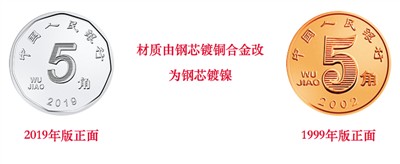
According to reports, the color of metal coins is determined by its material. In the past, 50-cent coins were yellow because their basic materials were all copper-containing alloys. From 1980 to now, the five-cent coins circulating in China have been made of copper, copper-zinc alloy and copper-plated alloy with steel core. The five-cent coin we use today belongs to the fifth set of RMB five-cent coins in 1999 edition, and its material is copper-plated alloy with steel core.
In the 2019 edition, the fifth set of RMB 50 cents will be made of nickel plated steel core. The color of natural coins changed from golden yellow to nickel white.
So, why do you want to change the material of a dime?
China Banknote Printing and Minting Corporation told reporters that, firstly, the anti-tarnishing performance of coins will be significantly improved by changing the copper-plated alloy of steel core to nickel-plated steel core; Secondly, the production process of copper-plated alloy on steel core used in the fifth set of RMB 50 coins in 1999 edition is an outdated process to be eliminated according to the national industrial policy, so it is no longer used.
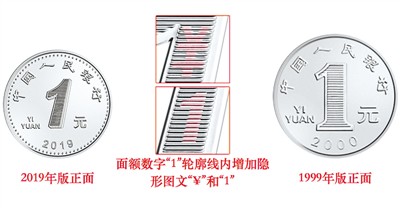
In addition, China Banknote Printing and Minting Corporation also answered some other questions of the reporter. For example, the inner circumference of the front and back of the new 50-cent coin is adjusted to a polygon because of the circle, which is convenient for special groups (amblyopia) to identify; The diameter of the new 1 yuan coins was adjusted from 25mm to 22.25mm, and the diameter was reduced by 11%, so as to be convenient for the public to carry and use.
The new coins issued this time are also innovative in anti-counterfeiting technology. For example, there are a group of invisible graphics and texts "RMB" and "1" in the digital outline of the front face of the new 1 yuan coin. When you turn a coin, you can observe "RMB" from a specific angle, and "1" from another angle. This invisible graphic carving technology is recognized as an advanced public anti-counterfeiting technology in the field of international coinage. After adding invisible graphic features to new 1 yuan coins, the anti-counterfeiting performance will be significantly improved, and the public will be able to identify the authenticity more easily.
What is the innovation of banknote anti-counterfeiting printing technology?
More banknotes are "sparkling"
If you take out the 2015 edition of 100 yuan banknotes and compare them with other denominations issued earlier, the most intuitive difference is that the denomination number in the middle of the former is more "shiny". With the change of observation angle, the color of the number "100" will alternate between gold and green, and a light band can be seen rolling up and down the number. This "sparkling" effect is also the origin of people giving it the nickname "local gold".
The reason why the 2015 edition of 100 yuan paper money has this effect is because of the use of glorious light change technology in denomination figures. At one time, this technology made the 2015 edition of 100 yuan banknotes "stand out from the crowd" among its banknote "brothers", while the banknotes of other denominations finally "turned over" with the issuance of the new RMB in 2019.
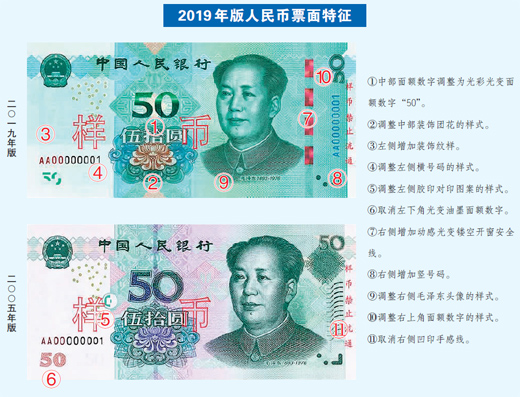
According to the introduction of China Banknote Printing and Minting Corporation, on the basis of the current anti-counterfeiting technology of the fifth set of RMB banknotes (50 yuan, 20 yuan and 10 yuan banknotes in 2005 and 1 yuan banknotes in 1999), the fifth set of RMB banknotes in 50 yuan, 20 yuan and 10 yuan in 2019 has also increased the number of denomination changes, which has a "sparkling" effect.
Moreover, the anti-counterfeiting features such as optically variable hollowed-out window security line, magnetic full-buried security line, vertical number and white water seal used in the 2015 edition of RMB 100 have also been applied to the banknotes of 50 yuan, 20 yuan and 10 yuan this time. It can be said that the original "brother" has, and this time the "brothers" basically have it. According to the People’s Bank of China, "50 yuan, 20 yuan, 10 yuan and 1 yuan banknotes are serialized with the anti-counterfeiting technology and layout of the fifth set of RMB 100 yuan banknotes in 2015 edition".
There are not only additions, but also some subtractions in the anti-counterfeiting technology of the new version of RMB. For example, in 50 yuan, 20 yuan and 10 yuan, the holographic magnetic window opening safety line and gravure touch line are cancelled, and in 50 yuan, the denomination number of optically variable ink is cancelled. On the other hand, 1 yuan paper money has added a magnetic full-buried security line and a white watermark. Generally speaking, the anti-counterfeiting technology of the new version of RMB is more advanced, the layout is more reasonable, and the overall anti-counterfeiting ability is obviously improved compared with the existing banknotes.
Regarding the hot question "Where are the 5 yuan banknotes?", the People’s Bank of China said: "In recent years, the People’s Bank of China has continuously increased the research and development of new technologies for currency printing. In order to improve the anti-counterfeiting ability and circulation life of RMB, 5 yuan banknotes with lower denomination and smaller circulation are currently selected for application research of related new technologies, and their issuance work is arranged separately."
What new technologies and "black technologies" will be applied to the mysterious 5 yuan banknotes? Will it turn into plastic money as rumored? We still need to wait and observe.

关于作者